Your Delivery Report, Explained
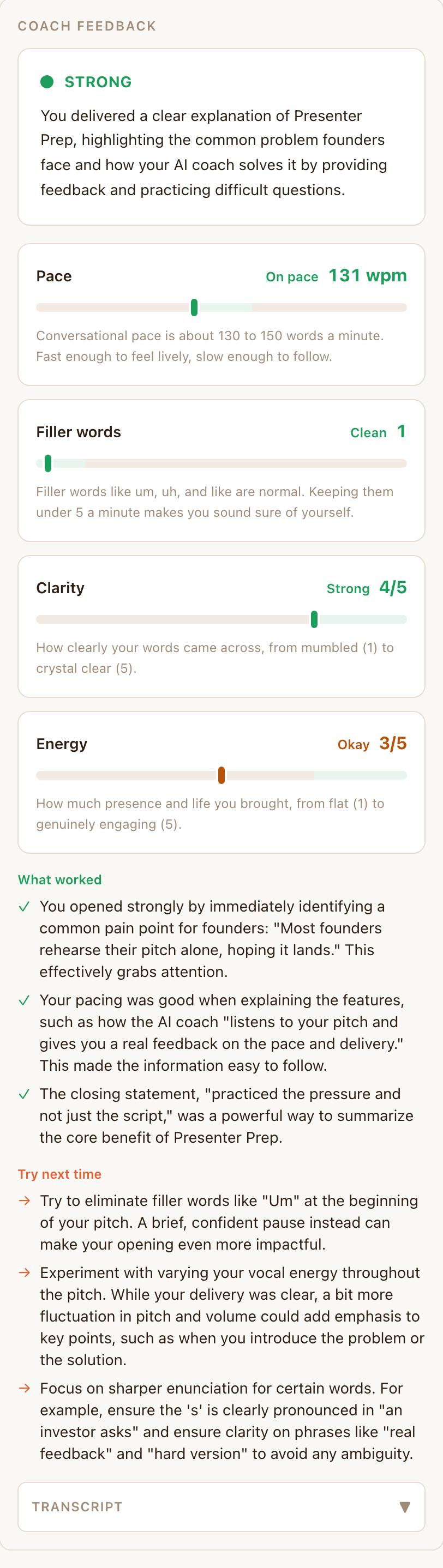
When you upload a recording to PresenterPrep, you get a delivery report: a plain-English read on how the run landed, four metrics that show how you sounded (pace, filler words, clarity, energy), a short list of what worked, a short list to try next time, and a full transcript you can click to jump around your own video. No deck required. You talk, you upload, you get read back to yourself the way an audience hears you.
This post walks through every part of that report so you know exactly what you are looking at and what to do about it.
What happens when you upload
You record yourself once, on your phone or your laptop, and drop the file in. A coach listens to the whole thing and reads it back as a report. You do not have to practice live with the voice coach to get this. An existing recording of a talk, a demo, a rehearsal, any of it works. Upload it and you get the same delivery breakdown.
The point is to make the invisible visible. You cannot hear your own pace while you are talking. You do not count your own filler words. The report does that for you so your prep has a target instead of a vague feeling that it went okay.
The overall read
At the top you get a plain-English read on how the run landed, color-coded from green to red. Green means it is strong and close to ready. Amber means it is getting there with real work left. Red means it is rough and worth another run. There is no grade and no number to obsess over, just a quick signal and a one-line summary of what happened, so you know whether to move on or run it again.
We keep it a read rather than a score on purpose. A number invites you to fixate on the digit instead of the delivery. The color plus the summary tells you what you need: did this land, and what is the headline. The detail lives in the four metrics below.
Pace: words per minute
Conversational pace is about 130 to 150 words a minute. Fast enough to feel lively, slow enough for a room to follow. Below roughly 110 you start to drag and lose people. Above roughly 170 you are rushing, and rushing reads as nerves even when you feel fine.
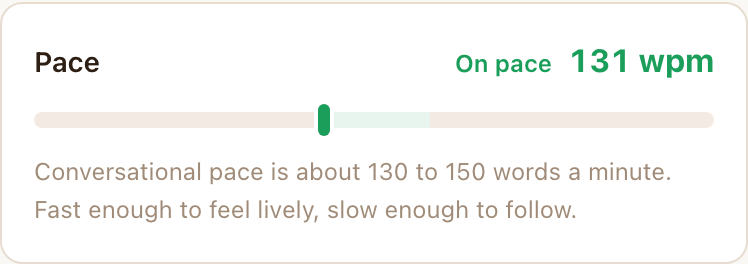
The report shows your pace as a marker on a bar, with the healthy band shaded. So you are not guessing whether 131 is good, you can see it sitting right inside the conversational band. Most people who think they talk too slow actually rush, and the bar settles that argument fast. If you are running hot, the fix is not talking slower word by word, it is adding pauses between your points. Pauses buy the room time to catch up and buy you time to breathe.
Filler words
Filler words like um, uh, and like are normal. Keeping them under about five a minute is what makes you sound sure of yourself. Everyone uses a few. The problem is not the existence of fillers, it is the density, and it is that every filler is a spot where you could have paused instead.
The report counts them and rates them per minute, so a longer talk is not punished for a higher raw count. When you see the number, resist the urge to eliminate fillers by force. Trying to scrub every um makes most people stiffer. The better move is to get comfortable with silence. A one second pause feels like an eternity to you and like confidence to everyone listening. Prep the pause and the fillers fall away on their own.
Clarity
Clarity is how crisp and easy to understand your words were, scored 1 to 5. A 1 is mumbled or swallowed. A 5 is crystal clear, every word landing. This is about articulation and enunciation, not vocabulary. You can use plain words and still score a 5, and you can use fancy ones and score a 2 because you trailed off at the end of every sentence.
Low clarity usually traces back to two habits: dropping your volume at the end of sentences, and racing through the parts you know best. Both are fixable with reps. When you can hear yourself go quiet on the last three words of a thought, you can catch it and finish strong.
Energy
Energy is how much presence and life you brought, scored 1 to 5. Flat and monotone is a 1. Genuinely engaging, with vocal variety and some visible investment in what you are saying, is a 5. Energy is the metric most people underestimate in themselves, and it is often the one holding you back.
Here is the honest catch: you almost always feel more energetic than you sound. What feels like enthusiasm in your head comes across as neutral on a recording. That gap is exactly why recording yourself matters. Push your energy to a level that feels slightly too much while you record, then play it back. Nine times out of ten, the too much version sounds just right.
What worked and what to try next
Below the metrics, the report gives you a few specific things that landed and a few to work on, tied to real moments in your talk. Not generic advice like be more confident, but pointed notes: the problem you set up at the start was relatable, or watch the filler words around the 55 second mark where you said but uh look for documents.
This is the part that turns the read into a plan. The color tells you where you are. These notes tell you the next thing to fix.
The transcript
Every report includes a full transcript, broken into short timestamped lines. Click any line and the video jumps to that moment. So when the notes point at something around 0:25, you can be there in one tap and hear it for yourself.
Reading your own transcript is uncomfortable and useful in equal measure. You see the sentence you thought was tight run on for four clauses. You see where you started three thoughts and finished one. That is the raw material for the next rep.
What to do with your report
One report is a snapshot. The value comes from the second, third, and fourth. Record the same talk again, watch the read shift from amber toward green, and let the what to try next notes be your checklist. Prep is reps, and the report is how you know the reps are working.
Upload a recording and read yourself the way your audience hears you. It is the fastest way to find the two or three things worth fixing before it counts. Try it at PresenterPrep.com.