The Famous Pitch Deck Report Card
Everyone publishes breakdowns of famous pitch decks. Nobody scores them.
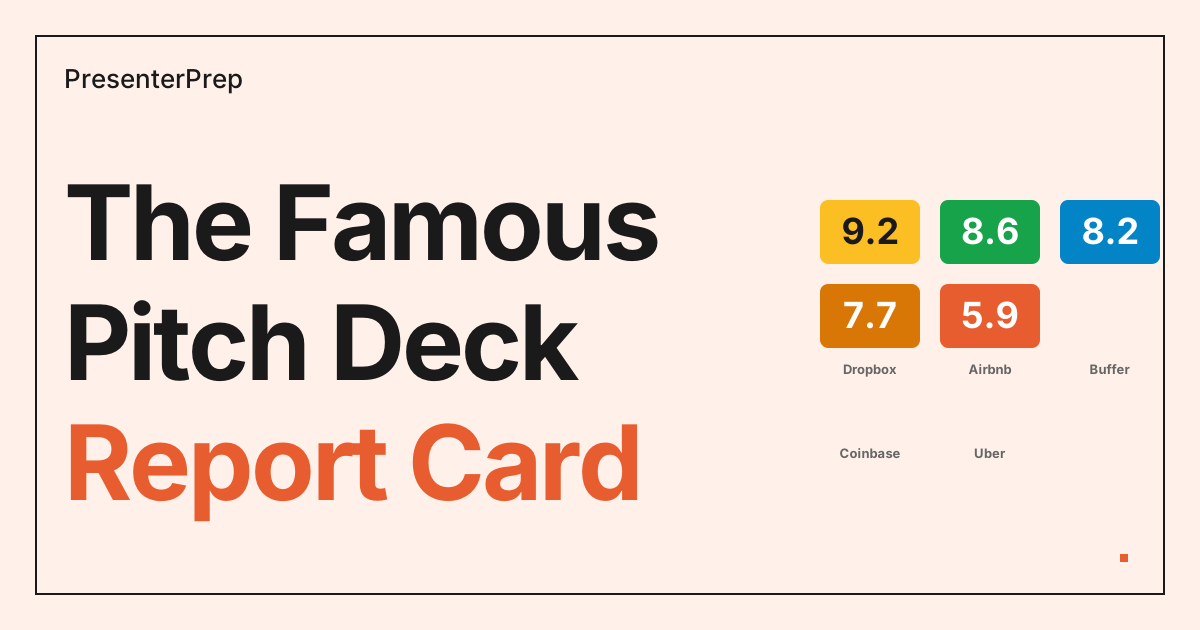
So we did. Five decks. Four dimensions. One number per deck.
The rubric is transparent: Clarity (does the deck describe the product in under thirty seconds?), Structure (is the story complete — problem, solution, market, model, team?), Traction (is there evidence in the deck that people actually want this?), and Outcome (what did the deck help build?). Each dimension is scored 0–10. The overall score is a weighted average.
The results are not what you’d expect.
Clarity 30% · Structure 30% · Traction 20% · Outcome 20%
Score reflects the deck as submitted — not the company it became.
Seventeen slides. No visual polish. Sequoia led the round anyway — and then published the deck on their own website as a template for every founder who came after.
The Dropbox deck earns a perfect score on clarity and structure because it did both things completely: it named a problem everyone had lived that week (“storage is a mess”), it showed the product doing the work instead of describing it, it explained why the moment was right, and it presented the competition table without cheating on the axes. No wasted arguments. No inflated TAM. No five-year model that wasn’t real yet.
The traction score is 7 because the deck’s primary evidence was a demo video that had driven 70,000 people onto a waitlist — strong proof of demand, but pre-revenue. The structure more than compensated.
The Airbnb seed deck is off-center. The type is inconsistent. The hero image is a screenshot of a website that no longer exists. It is the most-referenced pitch deck in startup history.
The nine on clarity comes from eight words: “Book rooms with locals, rather than hotels.” That’s the cover slide. Complete company description, total market context, competitor framing — all in under a breath. The nine on structure comes from twelve lean slides that told one story and stopped. No financial projections that weren’t real. No roadmap that was guesswork.
The traction was modest — three real events with real bookings. The founders showed it anyway. Honest evidence beats inflated forecasts every time, and that is why the deck still holds up.
Buffer gets the only perfect traction score on this list. $150,000 in annual recurring revenue. 800 paying customers. 97% gross margins. At seed stage. From two first-time founders nobody had heard of.
The deck led with those numbers instead of hiding them on slide nine. That one structural choice — put the traction where it earns the most trust — carried the raise. Two unknown founders closed $500,000 from 18 angels by letting the evidence speak first and the vision second.
The eight on structure reflects one real weakness: the competition slide killed momentum mid-raise. The founders rebuilt it after several meetings stalled. That willingness to iterate on a slide that was creating friction is itself a lesson worth studying.
The Coinbase deck opens with five words: “Your hosted bitcoin wallet.” Not “the future of money.” A wallet. In 2012, in a room of investors who mostly thought Bitcoin was a toy or a fraud, that framing was genius.
The nine on clarity is for making an incomprehensible technology feel safe and familiar. The eight on structure is for a strong “why now” slide — two legs, a macro shift in trust after the financial crisis and a Bitcoin-specific halving event — that answered the investor’s real objection before they asked it.
The three on traction is the honest score. The deck had almost nothing to show. What it had instead was a remarkably clear argument for why this would matter, delivered to the most skeptical room any deck on this list faced.
Twenty-five slides. No team slide. No business model slide. No stated ask. “Statistically optimized response time” — a phrase that appears in the deck and means nothing. By every structural measure, this deck should have failed.
It did not. It raised $200,000 and started a company worth roughly ninety billion dollars.
The Uber deck scores a four on structure because it genuinely deserves a four. The problem slides are the strongest two slides here — specific, verifiable, universally felt. Then the deck spends six slides re-explaining a concept the investor understood at slide three. The best timing argument in the deck arrives on slide twenty-one, after most investors have already made up their minds.
The lesson is not that structure doesn’t matter. The lesson is that undeniable conviction in the room can survive a structurally weak deck — and that Uber’s founders had it. Most founders don’t. Build the disciplined version of this deck. Then walk in with their conviction anyway.
The score that doesn’t fit the ranking
| Deck | Clarity | Structure | Traction | Outcome | Overall |
|---|---|---|---|---|---|
| Dropbox | 10 | 10 | 7 | 9 | 9.2 |
| Airbnb | 9 | 9 | 6 | 10 | 8.6 |
| Buffer | 8 | 8 | 10 | 7 | 8.2 |
| Coinbase | 9 | 8 | 3 | 10 | 7.7 |
| Uber | 7 | 4 | 3 | 10 | 5.9 |
Uber scores last on the deck and built the largest company. Coinbase scores last on traction and IPO’d at $86 billion. The deck score and the company outcome are not the same thing.
What they measure is different. The deck score measures how clearly the idea was communicated on paper. The outcome measures whether the founders were right about the market, whether they could execute, whether they showed up in the room with enough conviction to close. The deck gets you in the meeting. Everything after that is you.
Which is why practicing the pitch matters more than refining the deck. The Dropbox deck is the best on this list, and Drew Houston still had to sit across from Sequoia and answer hard questions about Google Drive. Uber’s deck was structurally rough, and Travis Kalanick still had to close a room of skeptical angels on a narrow premium bet. The deck is the floor. The pitch is the ceiling.
All five breakdowns: Airbnb · Buffer · Coinbase · Dropbox · Uber